
Why Nearly Everyone Should Consider Operating as a Church
Jul 11, 2026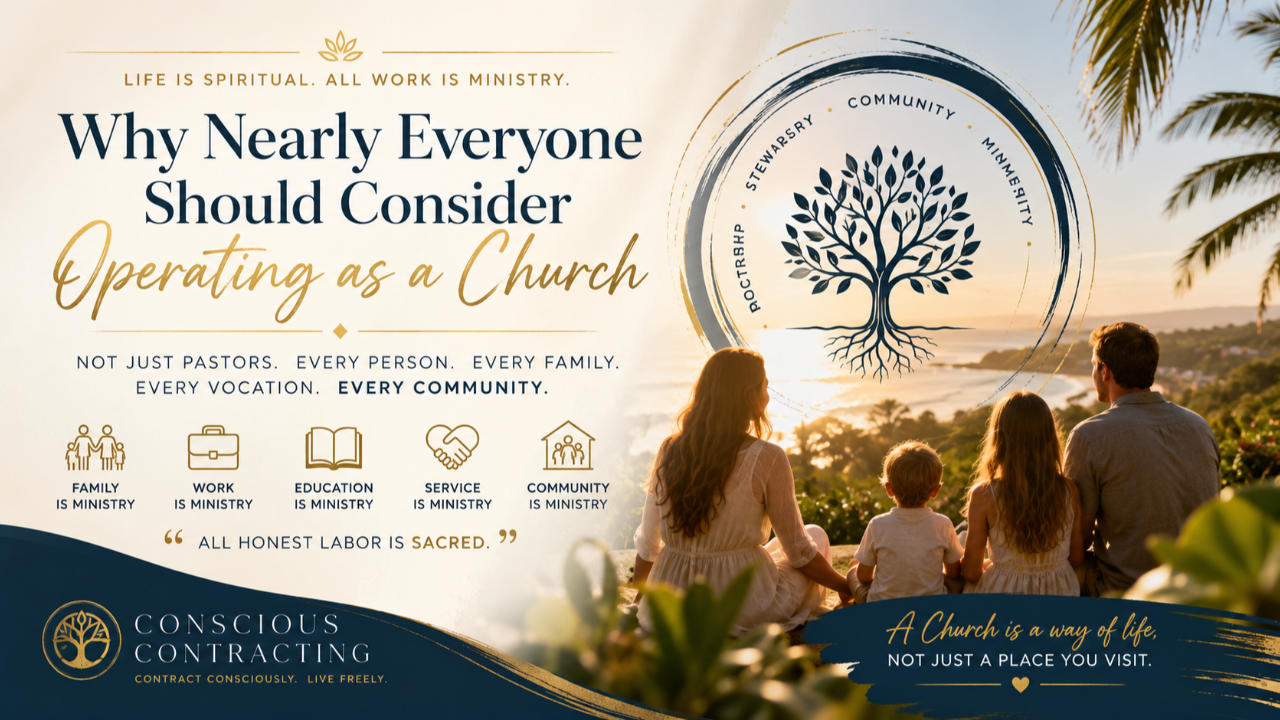
When you hear the word church, what comes to mind?
A building?
A pastor?
Sunday mornings?
A nonprofit asking for donations?
That's how most people have been taught to think about churches.
I believe that's one of the biggest misconceptions of our time.
What if a church isn't a place you go...
What if it's a way you choose to organize your life?
Historically, churches weren't simply places of worship. They were self-governing communities built around a shared doctrine, shared values, and a shared mission.
They educated their children.
They cared for their members.
They resolved disputes.
They stewarded property.
They conducted commerce.
They trained future leaders.
They served their communities.
In other words, they weren't one activity among many.
They were a complete way of life.
The False Divide Between "Sacred" and "Secular"
Somewhere along the way, we've been taught to separate life into two categories.
Church.
And...
Everything else.
Sunday is spiritual.
Monday through Friday is business.
Family is personal.
Work is economic.
Education belongs to the State.
Charity belongs to nonprofits.
Commerce belongs to corporations.
But who decided life had to be divided that way?
If you believe that every human being carries inherent dignity...that service to others has purpose...that honesty, stewardship, creativity, teaching, healing, and building are all expressions of something greater...
Then why wouldn't your work be spiritual?
Why wouldn't raising your children be ministry?
Why wouldn't caring for your community be an act of faith?
Perhaps the real question isn't whether life is spiritual.
Perhaps it's why we've been taught that most of it isn't.
A Church Is a Model of Self-Governance
This is where most people miss the point.
The greatest strength of a church isn't tax treatment.
It isn't legal paperwork.
It isn't a building.
The strength of a church is that it is designed to govern itself.
A church develops its own:
-
Doctrine
-
Leadership
-
Membership
-
Education
-
Discipline
-
Stewardship
-
Community
-
Mission
It creates a culture.
That's very different from most modern organizations, which tend to exist for a single purpose—running a business, managing an investment, or completing a project.
A church has the capacity to organize an entire way of life.
Why Settle for Less?
Over the last several years, private membership associations (PMAs) have become increasingly popular among those seeking greater privacy and autonomy.
And PMAs certainly have their place.
But they generally organize a relationship or a specific activity through contract.
A church can encompass far more.
A church can organize family, education, stewardship, commerce, charity, counseling, community, and service under a shared spiritual covenant.
It gives everyday life meaning.
A Different Question
Most people ask:"Can I start a church?"
I think there's a better question.
Why wouldn't you?
If all life is spiritual...
If your work is part of your calling...
If your family is part of your ministry...
If your purpose extends beyond making a living...
Then perhaps a church isn't a special institution reserved for clergy.
Perhaps it's the most natural expression of a life lived intentionally.
The Founders placed religious liberty first for a reason.
Not because worship happens one day a week.
But because a free people must always retain the right to organize their lives according to conscience rather than permission.
Maybe it's time we remembered what a church was always meant to be.
Next in this series: Church vs. PMA: Why a Church Is the Ultimate Form of Private Self-Governance
