
The IRS's 14 Characteristics of a Church Aren't a Test. They're a Blueprint.
Jul 22, 2026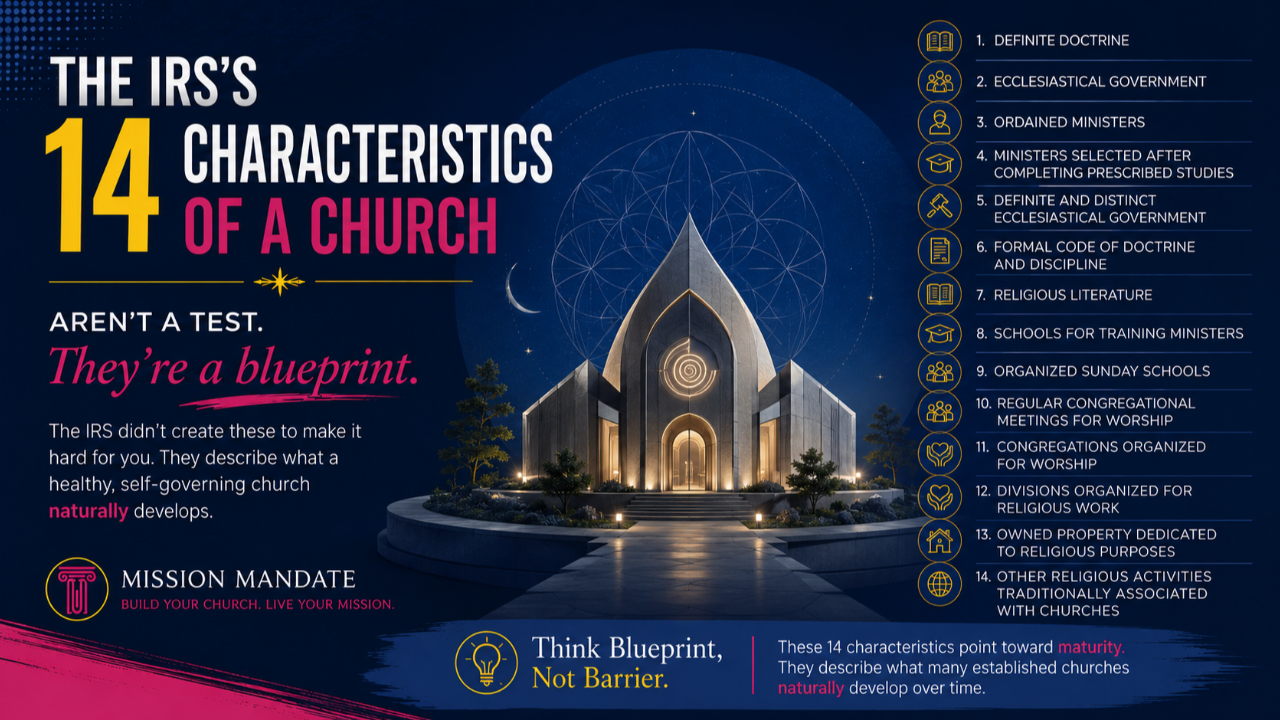
The IRS's 14 Characteristics of a Church Aren't a Test. They're a Blueprint.
One of the biggest mistakes I see people make is treating the IRS's 14 Characteristics of a Church like a checklist they have to survive.
"Do I have enough members?"
"Do I need a building?"
"What if I don't have ordained ministers?"
They're reading the list backwards.
I think the better question is this:
Why would the government even care about these things?
Look at what is actually on the list.
- Doctrine
- Ecclesiastical government
- Ministers
- Minister training
- Religious education
- Membership
- Worship
- Literature
- Leadership
Notice what isn't on the list.
Revenue.
Profit.
Market share.
Customers.
Employees.
The list isn't describing a business.
It's describing a self-governing society.
Every item points toward the same idea:
Can this community govern itself according to its own beliefs?
That's what makes the list so powerful.
Most people look at it and see obstacles.
I look at it and see a design manual.
The IRS accidentally handed you a blueprint for building a church with substance.
Think about it.
If you're going to establish a church, wouldn't you want:
- A clearly defined doctrine?
- A method of training future ministers?
- A leadership structure that survives you?
- A membership held together by covenant?
- A community that can educate, serve, and govern itself?
Of course you would.
Those aren't burdens.
They're strengths.
They're what make a church larger than a PMA.
Larger than a UNA.
Larger than a nonprofit.
Because a church isn't simply an organization.
It's a civilization in miniature.
That's why, inside Mission Mandate, I don't teach the 14 Characteristics as hurdles to overcome.
I teach them as a roadmap for building a church that will still be standing decades from now.
Because if your mission matters...
It deserves a structure that can outlive you.
