
The Passport Is the Certificate of Non-Citizen National Status
Sep 09, 2026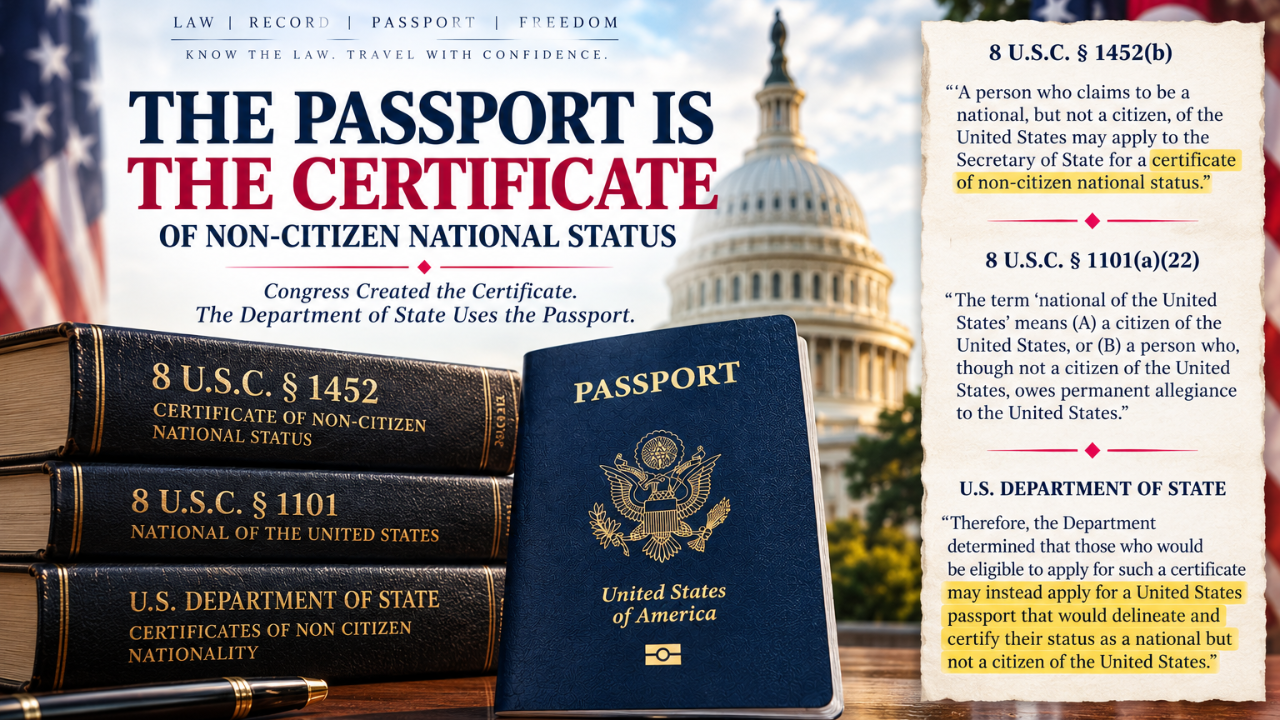
Congress Created the Certificate. The Department of State Chose the Passport as the Document to be the Certificate.
There is an unusually direct line between the United States Code and the Department of State’s published guidance concerning non-citizen national status.
Congress expressly created a statutory procedure through which a person claiming to be a national, but not a citizen, of the United States may apply to the Secretary of State for a certificate of non-citizen national status.
The Department of State then made an administrative decision that is equally significant: rather than design and issue a separate certificate, the Department determined that persons eligible for such certification could instead apply for a United States passport that would delineate and certify their status as a national but not a citizen of the United States.
The consequence is straightforward:
For an applicant whom the Department determines is legally eligible, the United States passport serves as the document through which the Department delineates and certifies non-citizen national status.
That proposition does not begin with social media, private interpretation, or speculation.
It begins with the text enacted by Congress and the Department of State’s own published explanation of how it administers that law.
Congress Expressly Created a Certificate of Non-Citizen National Status
The starting point is 8 U.S.C. § 1452, entitled:
“Certificates of citizenship or U.S. non-citizen national status; procedure.”
Subsection (b) is even more explicit:
“A person who claims to be a national, but not a citizen, of the United States may apply to the Secretary of State for a certificate of non-citizen national status.”
Congress did not merely recognize the phrase national but not a citizen.
Congress created an administrative procedure specifically directed to that classification.
Section 1452(b) provides that, upon proof satisfactory to the Secretary of State that the applicant is a national but not a citizen—and satisfaction of the applicable oath requirement—the individual is to be furnished with a certificate of non-citizen national status, subject to the territorial conditions stated in the statute.
The statutory text therefore establishes several distinct propositions.
First, Congress recognizes a legal category consisting of a person who is a national of the United States but not a citizen of the United States.
Second, Congress authorizes such a person to make an application to the Secretary of State.
Third, the application concerns a formal certificate of non-citizen national status.
Fourth, the Secretary is charged with determining whether the applicant has supplied satisfactory proof of that claimed nationality.
This is not merely definitional language.
It is an administrative mechanism created by federal statute.
Federal Law Separately Defines “National of the United States”
That statutory procedure must be read together with the Immigration and Nationality Act’s definitions.
Under 8 U.S.C. § 1101(a)(21):
“The term ‘national’ means a person owing permanent allegiance to a state.”
Then Congress provides the more specific definition in 8 U.S.C. § 1101(a)(22):
“The term ‘national of the United States’ means
(A) a citizen of the United States, or
(B) a person who, though not a citizen of the United States, owes permanent allegiance to the United States.”
The grammatical structure matters.
Congress did not define every national of the United States as a citizen.
It expressly divided the category into two branches:
(A) citizens of the United States; and
(B) persons who are not citizens of the United States but nevertheless owe permanent allegiance to the United States.
Thus, under the statutory definition:
Citizens are nationals.
But the statute also recognizes:
Nationals who are not citizens.
That distinction is indispensable to understanding § 1452(b). Without it, Congress’s separate provision for a certificate of non-citizen national status would make little sense.
Congress Created the Certificate — But the Department Did Not Create a Separate Physical Document
The next question is the critical one:
If Congress authorized a certificate of non-citizen national status, what document does the Department of State actually use to certify that status?
The Department answers that question on its own Legal Resources page entitled “Certificates of Non Citizen Nationality.”
The Department acknowledges at the outset that it receives requests for certificates of non-citizen national status under § 341(b) of the Immigration and Nationality Act, codified at 8 U.S.C. § 1452(b). (U.S. Department of State Travel)
It then explains why there is no separate certificate.
The Department states that, because it has received few requests, it found insufficient justification for designing a separate non-citizen national certificate containing anti-fraud protections.
Then comes the operative statement:
“Therefore, the Department determined that those who would be eligible to apply for such a certificate may instead apply for a United States passport that would delineate and certify their status as a national but not a citizen of the United States.” (U.S. Department of State Travel)
That sentence deserves careful attention.
The Department did not say that the statutory certificate disappeared.
It did not say that Congress repealed § 1452(b).
It did not say that certification of non-citizen national status was abandoned.
Instead, the Department explains that it chose not to manufacture a separate document for that purpose.
The Department uses the United States passport as the document that performs the delineating and certifying function for those it determines are eligible.
In That Administrative Framework, the Passport Is the Certificate
There is a difference between saying:
“Congress authorized a certificate.”
and saying:
“The Department created a separate paper certificate.”
Congress did the first.
According to the Department of State, the Department deliberately declined to do the second.
Instead, its published position is that an eligible person may apply for a United States passport that will:
delineate
and
certify
that person’s status as a national but not a citizen of the United States. (U.S. Department of State Travel)
That makes the legal relationship remarkably clear.
The statute supplies the authority for the certificate.
The Secretary of State determines whether the applicant has established the claimed status.
The Department uses the passport as the certifying document instead of creating a separate certificate.
That is why the statement—
THE PASSPORT IS THE CERTIFICATE
—is not simply a slogan.
Properly stated, it describes the Department’s chosen method of implementing the certification contemplated by § 1452(b) for applicants the Department determines are eligible under the governing nationality laws.
That final qualification matters because § 1452(b) establishes a procedure for certification; it does not itself make every person who claims the classification legally entitled to it.
The Secretary must be satisfied that the applicant actually possesses the nationality claimed.
The Department Specifically Directs Eligible Applicants to the DS-11 Passport Process
The Department’s guidance does not stop after identifying the passport as the certifying instrument.
It states that a person who believes he or she is legally eligible as a non-citizen national, and who complies with § 341(b) of the INA, may apply for a passport at a Passport Agency or passport acceptance facility in the United States.
The Department further states that the applicant must:
execute Form DS-11;
present documentary proof of non-citizen national status; and
establish identity. (U.S. Department of State Travel)
That administrative sequence is important.
The Department itself connects:
8 U.S.C. § 1452(b)
to
the Secretary of State
to
proof of non-citizen national status
to
Form DS-11
to
the United States passport.
The passport is therefore not being introduced into the discussion by inference alone.
The Department places it directly inside its explanation of the statutory certification process.
The Three Authorities You Should Read for Yourself
Start with these three sources.
1. 8 U.S.C. § 1101(a)(22)
This is the federal definition of “national of the United States.”
It expressly recognizes both citizens and persons who, though not citizens, owe permanent allegiance to the United States.
Official U.S. Code:
https://uscode.house.gov/view.xhtml?req=granuleid:USC-prelim-title8-section1101
2. 8 U.S.C. § 1452(b)
This is the provision entitled:
“Application to Secretary of State for certificate of non-citizen national status; proof; oath of allegiance.”
It states that a person claiming to be a national but not a citizen may apply to the Secretary of State for such a certificate.
Official U.S. Code:
https://uscode.house.gov/view.xhtml?req=granuleid:USC-prelim-title8-section1452
3. Department of State — Certificates of Non Citizen Nationality
This is where the Department explains that it decided against manufacturing a separate certificate and instead permits eligible applicants to apply for a passport that will delineate and certify their status. (U.S. Department of State Travel)
Department of State:
https://travel.state.gov/content/travel/en/legal/travel-legal-considerations/us-citizenship/Certificates-Non-Citizen-Nationality.html
This Is Why We Created the American National Passport Cohort
Reading the statutes is the first step.
Actually assembling the records, understanding the process, preparing the application, and getting through the administrative sequence is another matter entirely.
That is why we created the American National Passport Cohort.
The Cohort is designed for people who are finished collecting disconnected screenshots and are ready to work through the process in an organized sequence.
We walk students through the documentation, authentication process, explanatory materials, DS-11 preparation, passport appointment, and the subsequent administrative-record process.
The objective is not blind belief.
It is the opposite.
READ THE LAW.
UNDERSTAND THE PROCESS.
BUILD THE RECORD.
MAKE YOUR OWN INFORMED DECISION.
If you have been researching this subject but have never completed the process, the Cohort gives you the structure and accountability to finally move through it.
Space is limited.
JOIN THE AMERICAN NATIONAL PASSPORT COHORT
https://www.consciouscontracting.life/passportcohort
The Bottom Line
Congress enacted 8 U.S.C. § 1452(b) and expressly provided that a person claiming to be a national but not a citizen of the United States may apply to the Secretary of State for a certificate of non-citizen national status.
Congress separately defined “national of the United States” to include both citizens and persons who, though not citizens, owe permanent allegiance to the United States.
The Department of State then explained how it chose to administer the certification contemplated by § 1452(b):
It did not create a separate physical certificate.
Instead, for those legally eligible, it determined that the person may apply for a United States passport that would delineate and certify the person’s status as a national but not a citizen of the United States. (U.S. Department of State Travel)
Congress created the certificate.
The Department chose not to manufacture a separate certificate.
The passport performs the certifying function for an eligible non-citizen national.
The passport is the certificate.
Read the law for yourself.
