
A Lawsuit Is Not a Boarding Pass
Jun 19, 2026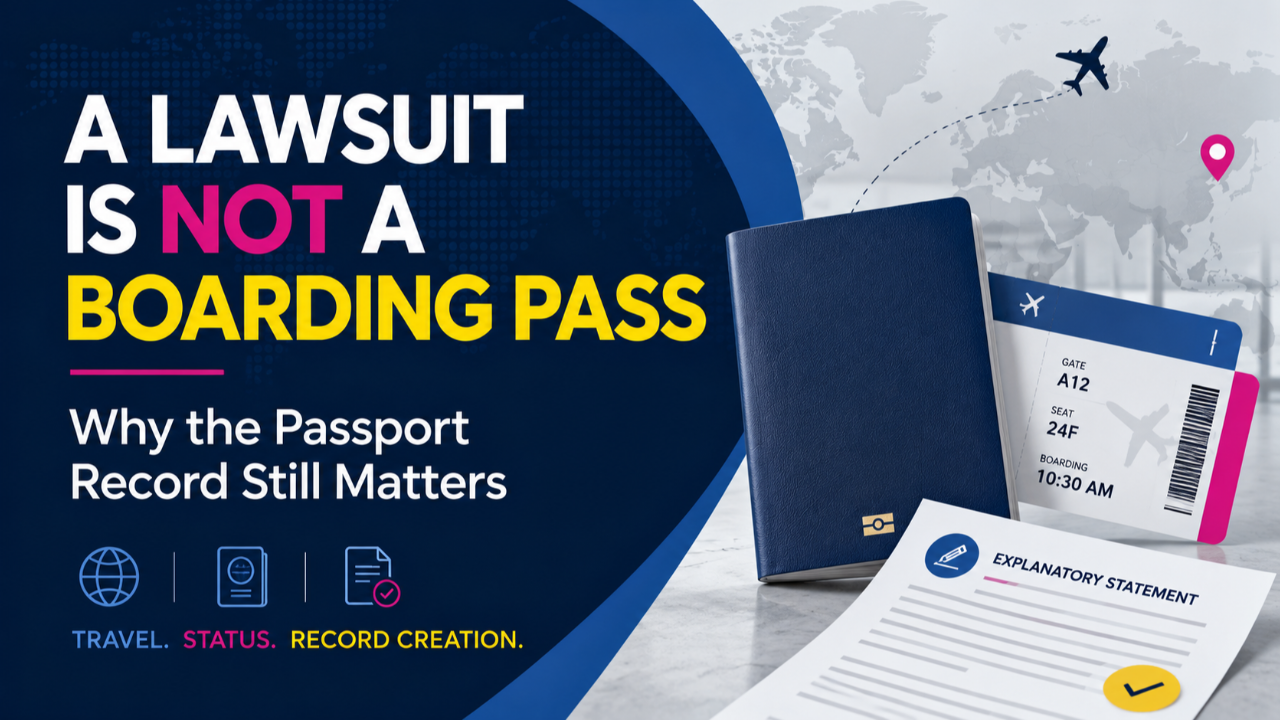
Why I Teach the American National Passport Process
There is a conversation going around right now about whether people should use a U.S. Passport at all.
The argument usually sounds something like this:
“The passport belongs to the U.S. Government.”
Or:
“The passport is corporate property.”
Or:
“Why would a free man need a passport?”
And I understand the concern.
I really do.
Under federal regulation, a passport is treated as property of the U.S. Government (22 C.F.R. § 51.7 — “Passport property of the U.S. Government.”). That is not a secret. That is not hidden. That is not some great “gotcha.”
Okay.
And?
Because here is the practical question that's being dismissed:
What happens when you want to travel internationally?
Not theoretically.
Not in a meme.
Not in a comment section.
In real life.
At the airport.
With your bags packed.
With your family standing next to you.
With thousands of dollars already spent.
With the airline employee looking at you and saying:
“Where is your passport?”
Are you going to hand them a private ID?
Are you going to explain your political status at the check-in counter?
Are you going to debate the government, the airline, TSA, Customs, or the gate agent about your right to travel while the plane is boarding?
And if they stop you, what is the proposed solution?
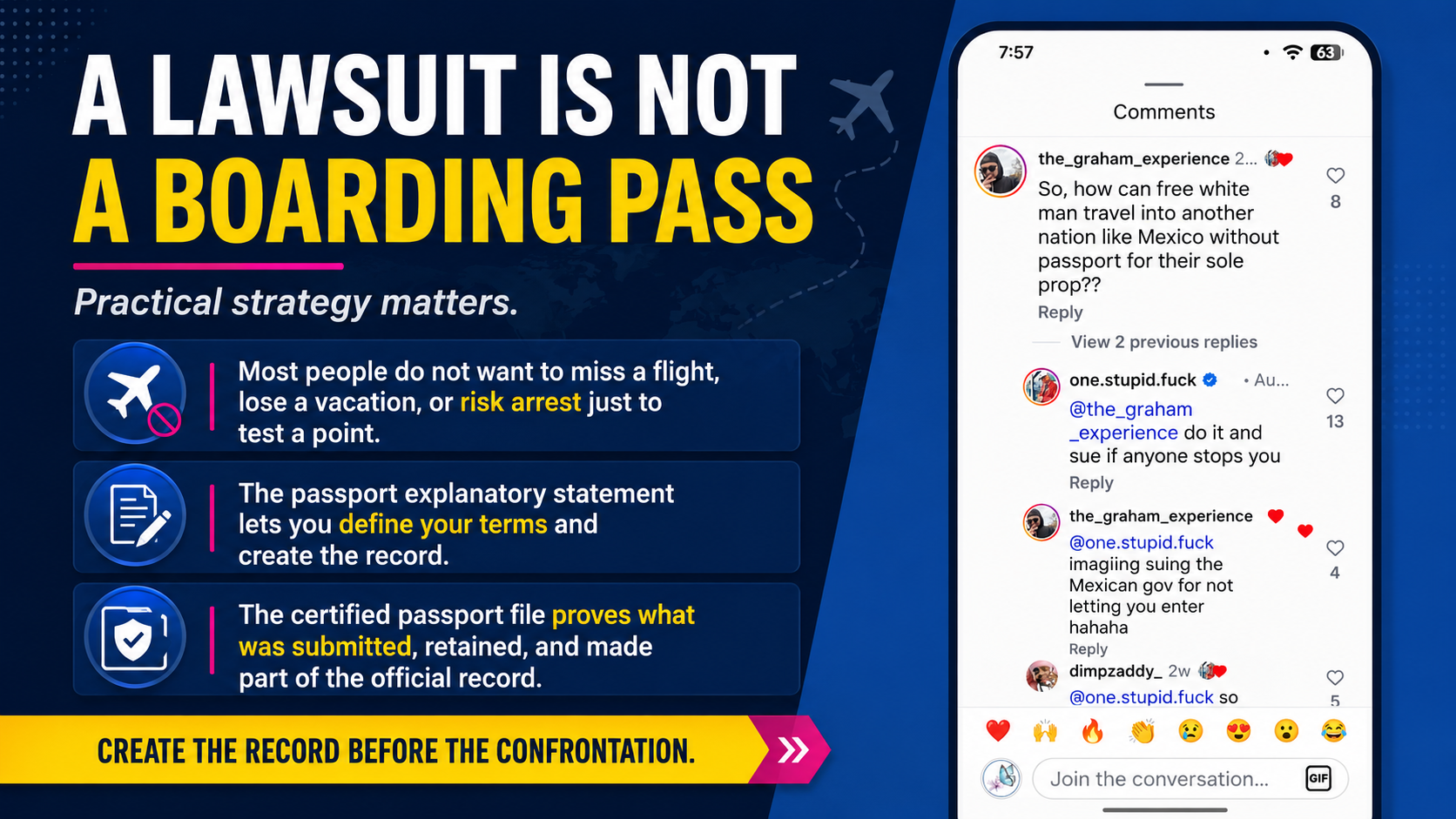
Sue them?
That is not a travel strategy.
That is a litigation strategy.
And most people do not want to plan an expensive vacation, get stopped, miss their flight, ruin the trip, and then spend a year or more fighting in a court system they already believe is corrupt.
“Just sue them” is not a serious answer for most families.
A lawsuit is not a boarding pass.
The Legal Argument Is Not the Same as the Practical Strategy
This is where people in the freedom space often lose the plot.
They find one legal issue, one regulation, one definition, one objection, and then act like that cancels the entire practical strategy.
Yes, there are concerns with the passport.
Yes, the passport is treated as government property.
Yes, there are issues with how the U.S. Government, corporate agencies, law enforcement, TSA, and foreign governments treat identity, status, nationality, travel, and jurisdiction.
That is exactly why the explanatory statement matters.
The solution is not to pretend the system does not exist.
The solution is to create the record before the confrontation.
That is the difference.
The Explanatory Statement Is Where You Set the Record Straight
The explanatory statement is the key.
That is where you address the concerns.
That is where you explain who you are.
That is where you define your political status.
That is where you clarify your relationship with the United States.
That is where you address your relationship with the ens legis, sole proprietorship, Social Security number, legal person, or public-facing identity the system is already interacting with.
That is where you set terms.
That is where you say:
I am not blindly accepting the default box.
I am not silently consenting to every presumption attached to U.S. Citizen status.
I am not showing up empty-handed and hoping a corporate policy enforcer magically understands who I am.
I am creating the record.
That is why the U.S. Passport process matters.
Not because the passport itself is the prize.
The passport is the visible instrument.
The explanatory statement is where the record gets built.
Try Handing a Private ID to TSA
Let’s get practical.
Try handing a private ID to TSA.
Try handing a private ID to an airline employee for international travel.
Try handing a private ID to a police officer who has already decided you are not cooperating.
We know you are right in principle.
Maybe you have a beautiful private document.
Maybe you can make a strong statement about your right to travel freely.
But in the moment?
You are dealing with people trained to recognize system documents.
They know driver licenses.
They know passports.
They know state IDs.
They know what their screen tells them.
They know what their policy manual tells them.
They are usually not trained to adjudicate your private political status on the side of the road or at Gate A12.
That does not mean you surrender.
I Have Personally Experienced the Difference
I have personally experienced why this matters.
I had a corporate policy enforcer — otherwise known as a cop — VERY excited to arrest me because I would not provide a driver license while traveling using my private property.
That was the energy.
That was where it was going.
But when he looked up my passport in the system, something changed.
He came back, deflated, and issued a citation instead of dragging me to jail.
Was that perfect?
No.
Was that the end of every issue?
No.
But did the passport record change the interaction?
YES!
“Just Sue Them Later” Is Not a Plan
There is a place for lawsuits.
There is a place for standing on principle.
There is a place for forcing accountability.
But “just sue them later” is a terrible default strategy for most people.
A lawsuit can take months.
Or years.
It can cost money.
It can exhaust your family.
It can be ignored, delayed, dismissed, redirected, or twisted by a corrupt system.
And even if you win, that does not give you back the vacation you missed, the business trip you lost, the family emergency you could not attend, or the dignity of not being dragged through chaos in the first place.
Smart strategy is not:
Hope for the best and sue later.
The Passport Is Practical Protection
People want to make this binary:
Either you are free and need no passport…
or you use a passport and therefore you surrendered.
That is too simplistic.
The real issue is not whether the passport exists inside a U.S. Corporation framework.
Of course it does.
The real issue is whether you are using the passport process consciously or unconsciously.
Are you blindly applying as the default U.S. Citizen?
Are you silently accepting every presumption attached to that box?
Are you using the passport as just another government ID?
Or are you using the process to create a record?
That is the difference.
The American National Passport process is about walking into the existing passport process with an explanatory statement, a claim, terms, evidence, and a record.
It is about using the system’s own administrative pathway to make your position visible.
This Is Why the Certified Passport File Matters
Most people stop at the passport.
I do not.
The passport is what you can hold in your hand and use to get past TSA.
But the certified Department of State passport file is the record behind it.
That file matters because it can show what you submitted, what was attached, what was retained, and what became part of the administrative record.
That is why I keep saying:
The passport is not the prize.
The record is.
And if you are serious about status, classification, contracts, presumptions, and your relationship to the U.S. system, then the record matters more than the internet debate.
Respectfully, “No Passport” Is Not the Higher Strategy for Most People
I respect people who are asking hard questions.
I respect people who do not want to blindly contract.
I respect people who do not want to be treated as property of a corporate system.
I respect people who are questioning the default.
Good.
Question it.
Get yourself a private ID too.
Create your own documents.
Build your private record.
But do not confuse a private ID with a working international travel strategy.
And do not confuse “I should not need a passport” with “I am prepared for what happens when the airline, TSA, Customs, foreign immigration, or a police officer refuses to honor my private position in real time.”
Those are not the same thing.
Most people do not want to miss the flight, ruin the vacation, scare their kids, get detained, get cited, get arrested, or spend the next year trying to prove a point inside the same court system they already know is compromised.
That is not sovereignty.
That is poor strategy.
The higher strategy is not walking into the confrontation empty-handed and hoping the system suddenly respects your private status when the system has spent your entire life concealing it from you.
The higher strategy is creating the record before the confrontation.
That is why the passport process matters.
Not because the passport booklet is magic.
Not because the government “owns” or “doesn’t own” the physical document.
Who cares?
The real question is:
What record did you create before you used it?
What terms did you place into the file?
What status did you claim?
What relationship did you define?
What presumptions did you rebut?
What evidence can you later obtain in certified form from the Department of State showing what was submitted, retained, and made part of the official record?
That is the difference between hoping the system honors your status…
and building a record the system has to interact with.
The Better Question
The better question is not:
“Does the U.S. Government claim ownership of the physical passport?”
The better question is:
“What record have you created around your status, your terms, your identity, your relationship to the United States, and the legal person the system presumes you are operating as?”
Because that is the real issue.
Not whether the government claims the booklet/ID Card.
But whether you have created the record.
Whether you have set your terms.
Whether you have explained who you are.
Whether you have rebutted the default.
Whether you have something practical to use before the confrontation starts.
Final Thought
A lawsuit is not a boarding pass.
A private ID is not automatically going to get you through TSA.
And being technically right after the fact is not the same as moving through the world strategically.
The American National Passport process matters because it gives you a way to engage the system with a record already created.
The explanatory statement matters because it is where you address the concerns.
The certified passport file matters because it is the proof of what you placed into the record.
And the passport itself?
It may not be the prize.
But in the real world, it can still be a very useful tool.
Especially when you stop using it blindly and start using the process consciously.
Citizen was the box they handed you.
Sovereign is the standing you have to claim.
And serious people create the record before the confrontation.
Learn How to Create a More Empowered Passport Record
Most people were never taught how to create a passport record on their own terms.
They were taught to fill out the form.
Check the obvious box.
Accept the default.
Submit the application.
And move on.
But the American National Passport process is different.
It is about understanding the status claim, the explanatory statement, the terms, the passport appointment, and the certified Department of State passport file behind the passport itself.
That is why I created a FREE course to walk you through the foundation.
You can see the process.
You can understand why the explanatory statement matters.
You can learn how the certified passport file fits into the bigger record-building strategy.
And then you can decide for yourself whether this is a record you are ready to create.
👉 Start the FREE Conscious Contracting Freedom Foundation Course here:
https://www.consciouscontracting.life/freedomfoundation
And if you want a little support and TLC while you move through the process, you can join one of our Passport Cohorts here:
https://www.consciouscontracting.life/passportcohort
The gate agent does not care about your political status.
Plan accordingly.
— Becky
