
The IRS Defines an Infant: What Was Filed When You Reached the Age of Majority?
Aug 07, 2026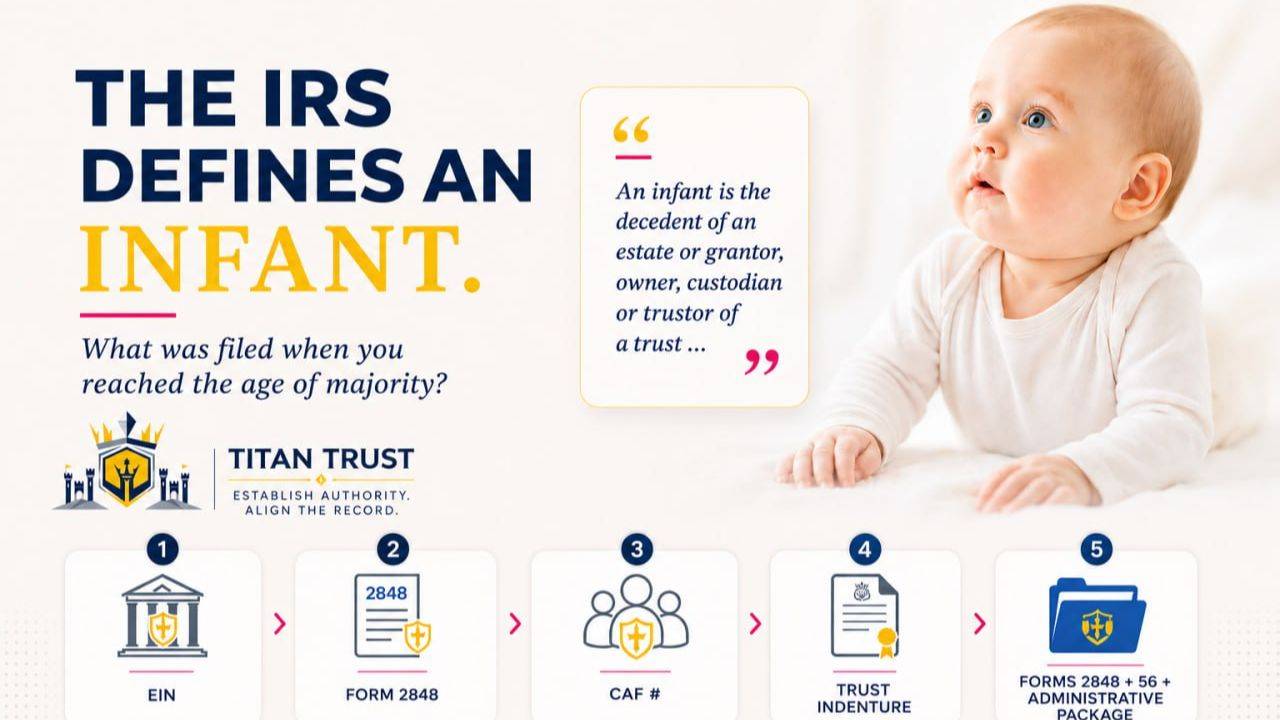
The IRS Defines an Infant: What Was Filed When You Reached the Age of Majority?
Most people know the IRS as the agency that receives tax returns, issues notices, and maintains taxpayer accounts.
Far fewer people have ever examined the language the IRS uses inside its own administrative procedures—especially the procedures used to assign Employer Identification Numbers to trusts and estates.
Buried inside those procedures is a statement that should stop you long enough to read it twice:
“An infant is the decedent of an estate or grantor, owner, custodian or trustor of a trust, guardianship, receivership or custodianship that has yet to receive an SSN.”
IRM 21.7.13.3.2.2(2)
That is not language created by a private teacher.
It is not language pulled from someone’s personal theory.
It is language the IRS uses in its own EIN-processing instructions. (IRS)
Read the Words Again
Infant.
Decedent.
Estate.
Grantor.
Owner.
Custodian.
Trustor.
Trust.
SSN.
These are not casual words. Each describes a position, relationship, entity, or identifying record recognized within the IRS administrative system.
The language matters because administrative systems operate through defined roles, identifiers, forms, and records. They do not function according to what you privately believe the relationship should be.
They function according to what has been established, submitted, processed, and placed in the record.
A Record Can Exist Before You Understand It
An infant does not complete an SSN application.
An infant does not choose the name placed on the record.
An infant does not examine the capacity, classification, or relationship reflected in a federal file.
Adults make those decisions and create those records while the child has neither the knowledge nor the capacity to direct the process.
You did not choose the record created during infancy.
You did not determine what identifiers would be assigned, what assumptions would attach to them, or how those identifiers would later be used throughout the public system.
But infancy is not where your authority ends.
It is where the unanswered question begins:
What did you affirmatively establish when you reached adulthood?
Your Birthday Changed Your Age—Not the Administrative Record
Reaching the age of majority changed your capacity to act.
You could sign agreements, open accounts, accept responsibilities, create trusts, administer property, and make decisions in your own right.
But your birthday did not automatically send the IRS a new administrative package.
It did not establish a Trust Indenture.
It did not obtain an EIN for a Tradename Trust.
It did not file a notice identifying a fiduciary relationship.
It did not place an adult Trustee record into the federal file.
Time passed.
Your capacity changed.
But the record continued speaking through the information already associated with the NAME and SSN.
That is why adulthood must become more than a date on a calendar.
It must become a position you deliberately establish and administer.
Stop Leaving the Adult Record to Assumption
Most people move through adulthood without ever asking what capacity the federal record reflects.
They use the same NAME.
They use the same SSN.
They answer notices personally.
They sign as the named taxpayer.
They continue interacting with the system through the record established before they had any ability to understand or direct it.
Then they assume the system somehow knows that their capacity changed.
But an administrative agency cannot process a structure it has never received.
It cannot examine a Trust Indenture that was never established.
It cannot record an authorization that was never submitted.
It cannot receive notice of a fiduciary relationship that was never formally communicated.
Silence leaves the existing record undisturbed.
Titan Trust is about ending that silence.
Status Is Established Through Structure and Record
Declaring yourself a Trustee is not the same as establishing a trust, occupying an actual Trustee office, and documenting the relationship through the administrative processes the receiving agency uses.
A declaration may express your intent.
A record demonstrates what you established.
That record should identify:
The Trust;
The Trustee;
The Tradename;
The identifying numbers connected to each record;
The representative authority submitted to the IRS;
The fiduciary relationship being noticed;
The relationship between the Tradename, Trust, and Estate; and
The evidence supporting the adult position being asserted.
The objective is not to collect random forms.
The objective is to create one coordinated record in which every name, number, capacity, instrument, and notice supports the same administrative position.
The Titan Trust Administrative Pathway
Titan Trust teaches a deliberate sequence for moving from an infancy-created record to an adult-administered fiduciary structure.
1. Establish the Tradename Trust and Obtain Its EIN
The first step is identifying the Trust separately from the SSN-connected record.
The EIN gives the Trust its own federal tax-administration identifier. It becomes the consistent identifying number used throughout the supporting Trust and administrative records.
An EIN is not the entire strategy.
It is the foundation on which the remaining filings are built.
2. Submit Form 2848 for the Trust
Form 2848 is titled Power of Attorney and Declaration of Representative. The IRS uses it to authorize an eligible individual to represent an identified taxpayer before the agency for specified tax matters and periods. (IRS)
The form matters because the IRS does not have to guess who is authorized to act.
The authorization is affirmatively placed into the agency’s own system.
3. Establish the CAF Record
When the IRS first records a third-party authorization, it assigns the representative a unique nine-digit Centralized Authorization File number.
That CAF number is then used on future authorizations submitted for processing. (IRS)
The EIN identifies the Trust.
The CAF number identifies the representative within the IRS authorization system.
Different numbers.
Different records.
Different functions.
Titan Trust teaches you how those separate pieces operate together.
4. Establish the Trust Indenture
The private Trust does not arise merely because an EIN or IRS form exists.
The Trust Indenture establishes the governing structure. It identifies the Trust, the Trustee office, the purpose, property, powers, duties, administration, and succession provisions.
The indenture is the underlying instrument.
The IRS forms communicate specific relationships arising from that structure.
Private authority and administrative notice must support one another.
5. Give Notice of the Fiduciary Relationships
Form 56 is titled Notice Concerning Fiduciary Relationship.
The IRS states that the form is used to notify it of the creation or termination of a fiduciary relationship under Internal Revenue Code section 6903. The instructions also distinguish a fiduciary from an authorized representative: a fiduciary acts because of the underlying relationship, while a representative acts within the authority stated on Form 2848. (IRS)
That distinction is essential.
Form 2848 addresses representation.
Form 56 addresses the fiduciary relationship.
The Trust Indenture supplies the underlying private authority.
The Titan Trust administrative package coordinates those records, addresses the age-of-majority transition, and communicates how the Tradename, Trust, Trustee, and Estate relationships are intended to be administered.
The Record Must Tell One Complete Story
A strong administrative package does not depend on an IRS employee assembling the theory for you.
It tells the story in a controlled order.
It identifies the parties.
It distinguishes the SSN-connected record from the EIN-connected Trust.
It identifies the Trustee.
It establishes the governing instrument.
It records the representative authorization.
It gives notice of the fiduciary relationship.
It includes the evidence supporting the age-of-majority position.
It preserves proof of submission and delivery.
This is what it means to stop leaving the record to assumption.
You are no longer waiting for the system to infer your adult position.
You are establishing it.
You Inherited the Record. You Decide What Comes Next.
You could not control what was created during infancy.
You can control whether you remain silent in adulthood.
You can establish the Trust.
You can occupy the Trustee office.
You can use the IRS’s own forms and administrative systems.
You can give notice of the relationships.
You can preserve the evidence.
You can build a record that reflects the structure you are prepared to administer.
The adult position is not created by shouting a title louder.
It is built through deliberate action.
Establish the structure.
Document the authority.
Notice the relationship.
Correct the record.
Administer from the position you established.
Establish Your Titan Trust
Titan Trust walks you through the complete process for establishing the Tradename Trust, obtaining the EIN, submitting the relevant IRS authorizations and fiduciary notices, building the age-of-majority administrative package, and maintaining the complete record.
Stop allowing the record created during infancy to remain the only record speaking for you.
Explore the Titan Trust Strategy:
