
Free 3-part webinar series and discover the Fiduciary Voice.
Jul 18, 2026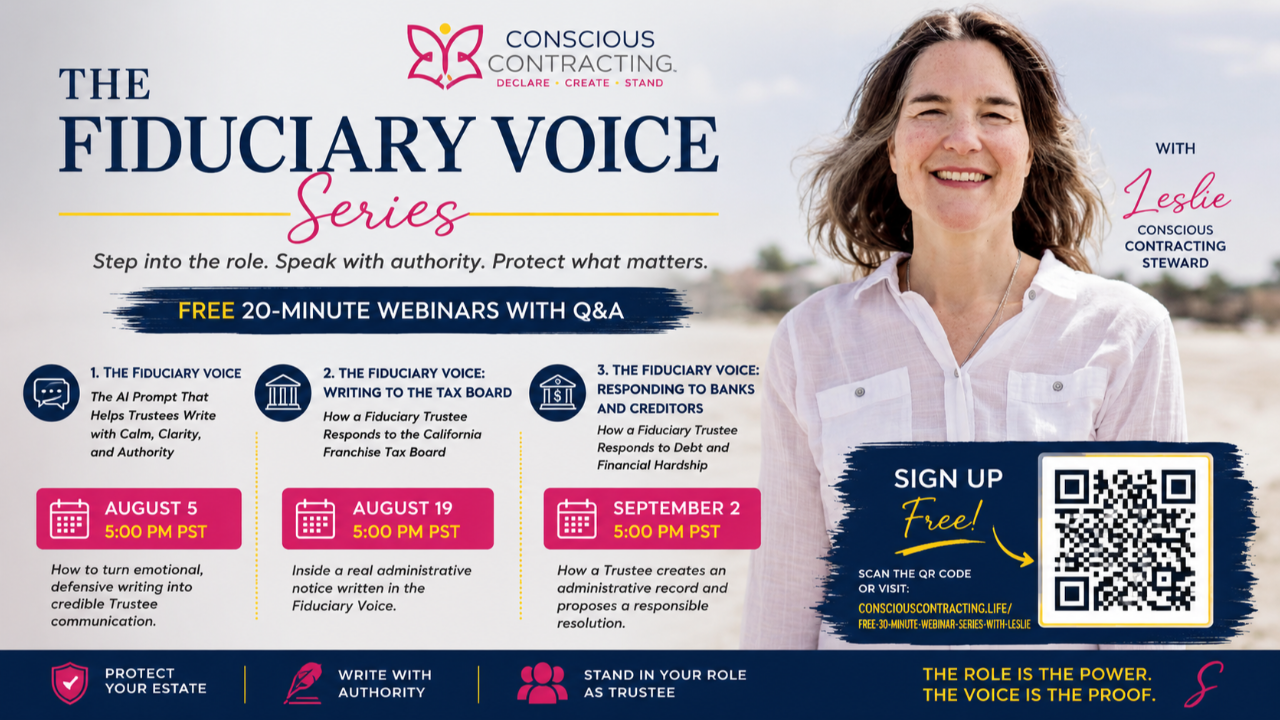
The Fiduciary Voice: Why the Way You Communicate Matters More Than Ever
Most people believe that if they simply learn enough law, quote enough statutes, or find the right case, the system will eventually do the right thing.
Experience tells a different story.
Banks protect their interests.
Agencies protect their records.
Creditors protect their revenue.
And courts do not always dispense justice the way we were taught to expect. Too often, the system rewards procedure, presumption, and institutional momentum over truth.
That doesn't mean you give up.
It means you stop walking into those relationships unprepared.
It means you stop reacting emotionally.
It means you learn to communicate differently.
Every Letter Creates a Record
Every time you respond to an IRS notice...
A bank...
A creditor...
A tax board...
Or any government agency...
You are creating an administrative record.
Your words matter.
Not because they magically change reality.
But because they establish your position, define the relationship, preserve the facts, and demonstrate whether you are communicating with clarity—or simply reacting out of fear, frustration, or confusion.
Far too many people unknowingly strengthen the very position they are trying to overcome.
Not because they lack intelligence.
But because they are responding from the wrong place.
The NAME Has a Voice
If you've studied with Conscious Contracting, you've heard me talk about The NAME Game.
One of the biggest mistakes people make is assuming they are the NAME.
They answer every letter, every accusation, every application, every notice, and every demand from that assumption.
The result?
Their writing becomes emotional.
Defensive.
Argumentative.
Rambling.
Reactive.
They explain too much.
They admit things they didn't intend to admit.
They answer questions they didn't have to answer.
They strengthen presumptions they never meant to accept.
Just as silence writes contracts too...
So do your words.
The Fiduciary Voice
One of the hidden values inside the Titan Trust Strategy isn't another document.
It's a different way of thinking.
A different way of communicating.
A different way of administering.
We call that The Fiduciary Voice.
The Fiduciary Voice doesn't assume the institution is neutral.
It doesn't assume everyone is acting in good faith.
It doesn't rely on emotion.
It doesn't panic.
It doesn't attack.
It doesn't beg.
It doesn't over-explain.
Instead, it asks different questions.
Who is making the claim?
What relationship exists?
What capacity am I serving in?
What record am I creating?
What facts actually need to be established?
Then it communicates calmly, intentionally, and with discipline.
Not because calm language magically fixes a broken system.
Because disciplined administration creates a stronger record than emotional reaction ever will.
The Fiduciary Voice Is Part of the Titan Trust Strategy
The Fiduciary Voice is not simply a better way to write letters.
It is the voice of someone who understands that the NAME is an Estate to be administered—not an identity to speak through automatically.
That distinction is central to the Titan Trust Strategy.
The documents matter.
The Trust structure matters.
But the structure only becomes powerful when the Trustee knows how to stand in the proper capacity, recognize the relationship being asserted, and administer the record accordingly.
That is where many people get stuck.
They create a Trust, but continue communicating exactly as they did before.
They continue reacting as the NAME.
They continue defending the NAME.
They continue answering every institution as though the notice, debt, accusation, or demand is personally directed at the living man or woman.
The Fiduciary Voice begins when the Trustee stops collapsing those capacities.
A Trustee does not simply “write better.”
A Trustee writes from a different relationship to the matter.
The Trustee asks:
Who is being addressed?
What Estate or account is involved?
What capacity is being presumed?
What claim has actually been made?
What record needs to be created or corrected?
That is not a writing trick.
That is Trust administration.
And it is one of the hidden values of the Titan Trust Strategy.
Join Leslie's Free Three-Part Webinar Series
To help you develop this skill, Leslie is teaching a free three-part webinar series designed to introduce the principles behind The Fiduciary Voice and show how they apply in real-world situations.
Part 1
The Fiduciary Voice
The AI Prompt That Helps Trustees Write with Calm, Clarity, and Authority
Discover an AI framework that helps transform emotional, reactive writing into communication that reflects the discipline and mindset of a Fiduciary Trustee.
Tuesday, August 5
5:00 PM Pacific
Part 2
The Fiduciary Voice: Writing to the Tax Board
How a Fiduciary Trustee Responds to the California Franchise Tax Board
Walk through a real administrative notice and learn how the Fiduciary Voice changes the entire approach to responding.
Tuesday, August 19
5:00 PM Pacific
Part 3
The Fiduciary Voice: Responding to Banks and Creditors
How a Fiduciary Trustee Responds to Debt and Financial Hardship
Learn how a Trustee creates an administrative record, communicates with precision, and proposes thoughtful, responsible resolutions instead of reacting from fear or frustration.
Tuesday, September 2
5:00 PM Pacific
Reserve Your Seat
The Titan Trust Strategy is not about collecting documents and continuing to operate exactly as you did before.
It is about learning to recognize the NAME, administer the Estate, communicate in the proper capacity, and create a record that reflects the relationship you intend to hold.
The Fiduciary Voice is where that difference becomes visible.
Join Leslie for this free three-part series and see what changes when the Trustee—not the NAME—answers the letter.
Register free here:
https://www.consciouscontracting.life/Free-30-Minute-Webinar-Series-with-Leslie
