
The Church Is the Highest Form of Voluntary Self-Governance
Jul 23, 2026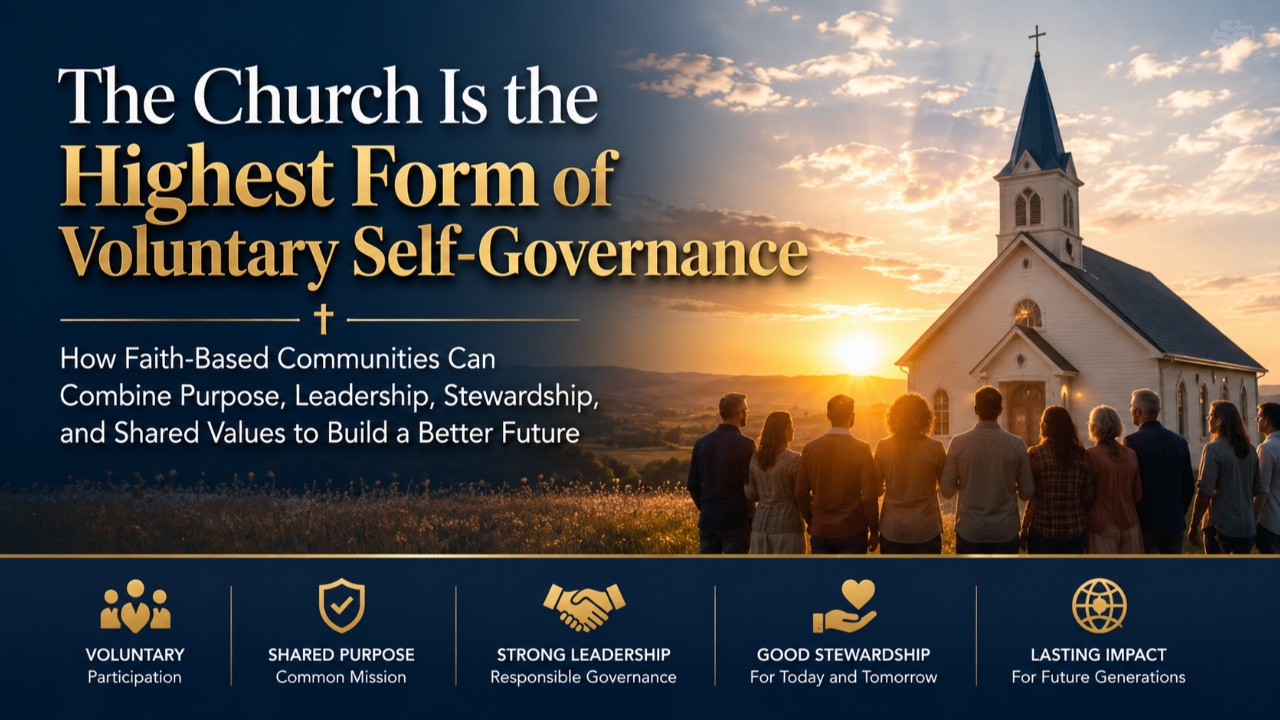
Everyone says they want freedom. But freedom always raises another question: Freedom to build what?
The word freedom is used often.
People talk about financial freedom.
Personal freedom.
Religious freedom.
Constitutional freedom.
But freedom, by itself, is only the absence of restraint.
The more important question is:
What are you going to build with it?
Throughout history, people have created different kinds of organizations to accomplish different purposes. Each has its own strengths and its own role.
Different Structures Serve Different Purposes
Businesses exist to organize commerce.
Nonprofit organizations exist to pursue charitable or educational objectives.
Private Membership Associations (PMAs) organize private relationships among consenting members.
Unincorporated Nonprofit Associations (UNAs) allow people to voluntarily associate around a shared purpose.
Each of these structures serves an important function.
Each provides a framework for people to work together toward common goals.
But there is another organizational model that has shaped communities for centuries.
A Church Is Built Around Mission
A church is more than an organization.
Historically, it has served as a community united by shared beliefs, common purpose, and voluntary commitment.
Rather than existing solely for commerce or charitable activity, a church often brings together multiple aspects of community life under one guiding mission.
Within that framework, members may voluntarily participate in:
- Teaching and education
- Leadership development
- Stewardship
- Community support
- Worship and shared gatherings
- Charitable outreach
- Long-term planning
- Passing values from one generation to the next
Its focus is not merely organizational—it is relational and mission-driven.
Voluntary Self-Governance
One of the defining characteristics of a church is that participation is voluntary.
People choose to become part of the community.
They voluntarily agree to its beliefs, values, and governance.
They commit themselves to a shared mission.
That voluntary commitment distinguishes self-governance from external control.
Instead of relying solely on outside direction, members intentionally work together according to principles they have adopted as a community.
More Than Structure
Every organization needs structure.
Policies.
Leadership.
Records.
Governance.
But structure alone doesn't create purpose.
Purpose gives structure its meaning.
Without a shared mission, even the best organizational system eventually loses direction.
When purpose comes first, governance becomes a means of supporting that mission rather than an end in itself.
Building Something That Lasts
The organizations that endure are often those that invest in more than administration.
They cultivate:
- Shared values
- Responsible leadership
- Stewardship
- Education
- Community
- Long-term vision
These elements help create organizations that can continue serving future generations.
Rather than focusing only on today's needs, they build with tomorrow in mind.
Freedom Is More Than Independence
Many people think freedom simply means escaping limitations.
But lasting freedom also involves responsibility.
It requires intentionally building communities, institutions, and organizations that reflect the values we hope to preserve.
Freedom is not simply the absence of control.
It is the opportunity to build something worthy of sustaining.
Mission Before Mechanics
Inside Mission Mandate, we explore how purpose, stewardship, governance, and community can work together to support mission-driven organizations.
The conversation isn't merely about organizational forms.
It's about creating a foundation that allows a mission to endure.
Because the greatest legacy isn't simply creating an organization.
It's building a community united by purpose, stewardship, and shared commitment.
