
Covenant vs. Contract: What's the Difference?
Jul 21, 2026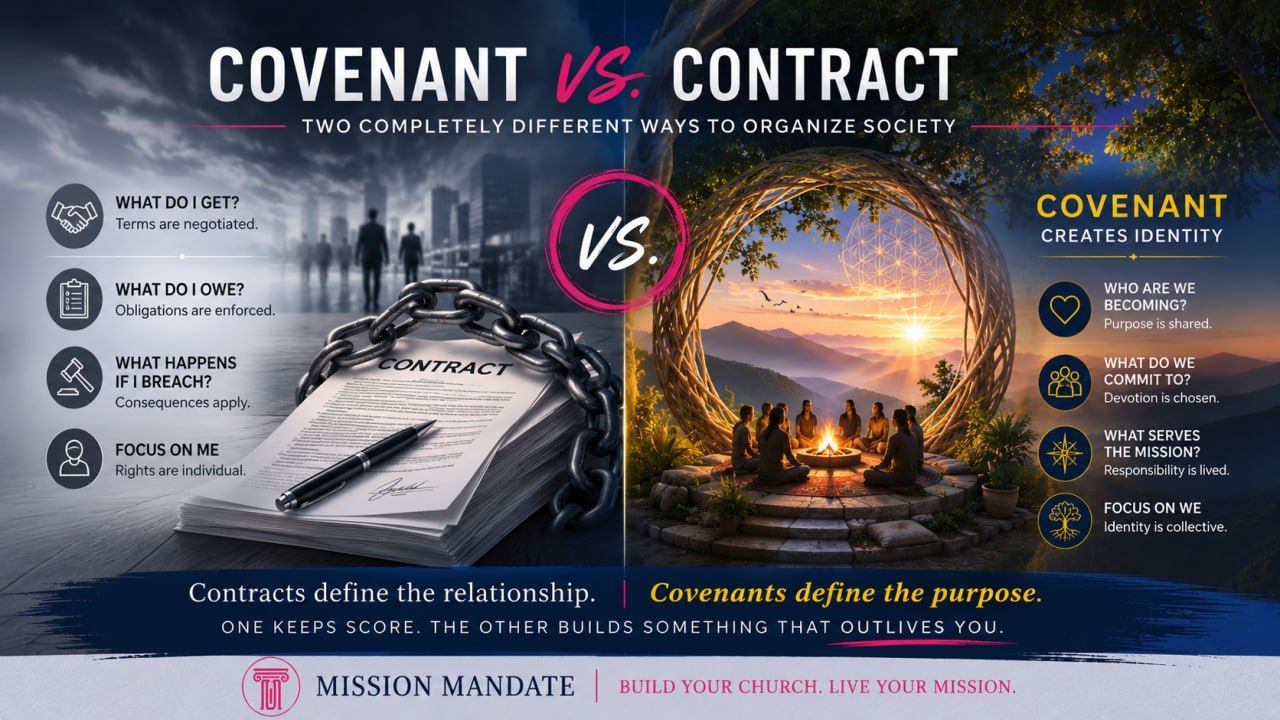
What if the strongest organizations aren't built on transactions—but on shared purpose?
Most of us interact with contracts every day.
We sign employment agreements.
We accept terms and conditions.
We enter business partnerships.
Contracts are an essential part of modern life because they define expectations, responsibilities, and obligations between parties.
But throughout history, another concept has shaped communities in a different way:
Covenant.
While the two words are sometimes used interchangeably, they describe very different ideas.
A Contract Defines an Agreement
A contract is designed to establish the terms of an exchange.
It answers questions like:
- What are each party's responsibilities?
- What is being exchanged?
- What happens if someone doesn't fulfill their obligations?
Contracts are valuable because they provide clarity and structure for specific relationships or transactions.
They help organize commerce, services, and legal responsibilities.
A Covenant Creates a Shared Commitment
A covenant begins from a different place.
Instead of asking only, "What do I receive?", a covenant asks:
"Who are we becoming together?"
Rather than focusing solely on an exchange, a covenant reflects a shared purpose, common values, and an ongoing commitment to a mission.
Historically, covenants have played an important role in religious communities, where they expressed not only obligations but also identity, stewardship, and collective responsibility.
Identity Before Activity
Organizations often succeed not simply because they have good policies, but because they share a common vision.
People understand why they exist.
They know what they stand for.
They recognize the values that guide their decisions.
That shared identity shapes culture.
It influences leadership.
It strengthens community.
It creates continuity across generations.
Building More Than Transactions
Contracts are excellent tools for organizing business relationships.
They establish expectations and define responsibilities.
But many mission-driven organizations seek to cultivate something deeper—a shared commitment to a purpose that extends beyond individual transactions.
Whether serving a community, educating others, or pursuing a common vision, a clearly defined mission often becomes the foundation upon which lasting organizations are built.
A Foundation for the Future
Every enduring organization begins by asking important questions:
- What values unite us?
- What purpose brings us together?
- How do we steward this mission responsibly?
- What kind of culture are we creating?
- How will this work continue beyond us?
These questions move beyond paperwork and encourage thoughtful leadership.
Mission Before Mechanics
Inside Mission Mandate, we explore how purpose, stewardship, leadership, and organizational planning can work together to build structures that reflect a shared mission.
The goal isn't simply to organize activities.
It's to organize a community around purpose.
Because lasting organizations are built on more than transactions.
They're built on shared vision, shared values, and shared commitment.
