
Church or Tax Classification? Understanding the Difference
Jul 16, 2026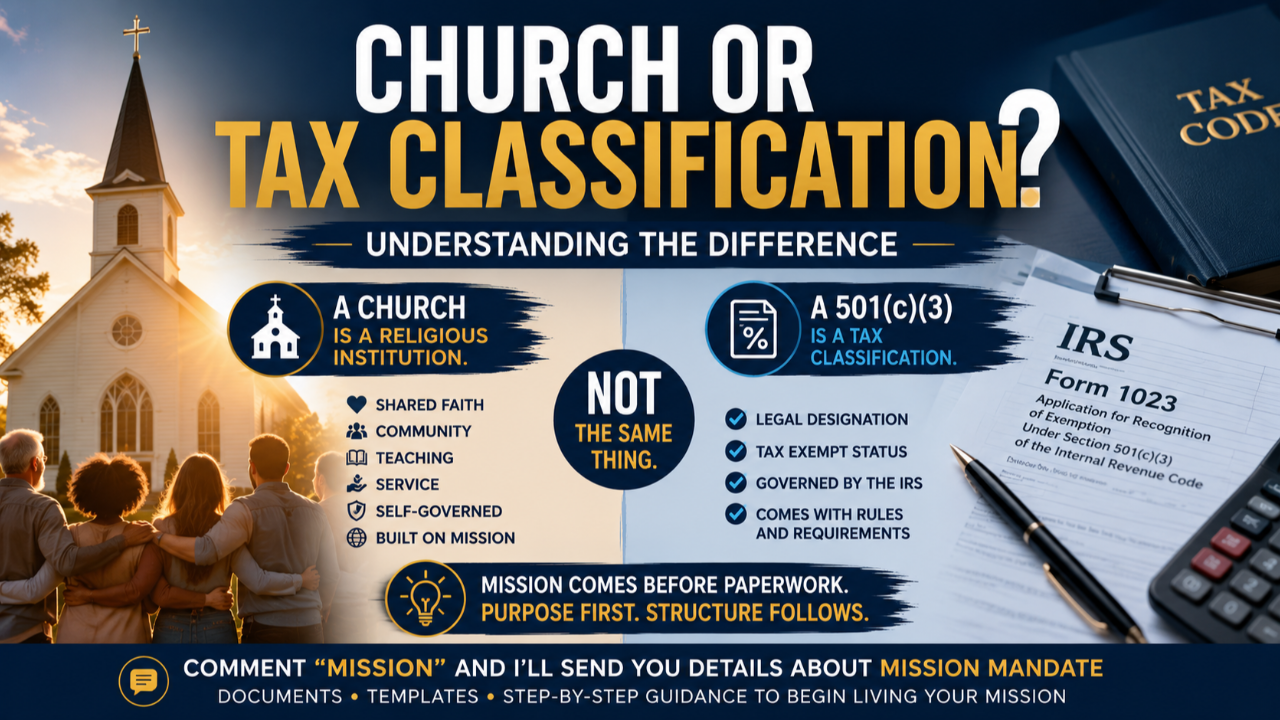
What if one of the biggest misconceptions is believing these two things are the same?
Many people use the terms "church" and "501(c)(3)" interchangeably.
But they describe two different concepts.
A church is a religious institution centered around a shared spiritual mission, beliefs, and community.
A 501(c)(3) is a section of the U.S. Internal Revenue Code that provides a specific federal tax classification for qualifying organizations.
Those are not the same thing.
Understanding the distinction is an important first step for anyone exploring how faith-based organizations have historically been established and governed.
A Mission Comes Before a Structure
Before any paperwork exists, there is usually a purpose.
Communities form because people share a common vision.
They gather around values.
They teach.
What if one of the biggest misconceptions is believing these two things are the same?
Many people use the terms "church" and "501(c)(3)" interchangeably.
But they describe two different concepts.
A church is a religious institution centered around a shared spiritual mission, beliefs, and community.
A 501(c)(3) is a section of the U.S. Internal Revenue Code that provides a specific federal tax classification for qualifying organizations.
Those are not the same thing.
Understanding the distinction is an important first step for anyone exploring how faith-based organizations have historically been established and governed.
A Mission Comes Before a Structure
Before any paperwork exists, there is usually a purpose.
Communities form because people share a common vision.
They gather around values.
They teach.
They serve.
They support one another.
Throughout history, religious communities often began with a mission long before formal organizational structures were developed.
The administrative structure came later to support that mission.
Start With the Right Question
Many people immediately ask:
"What forms do I need to file?"
While organizational documents have their place, there is an even more important question:
"What mission am I called to fulfill?"
When your purpose is clearly defined, decisions about structure become much easier to evaluate.
Instead of beginning with paperwork, you begin with vision.
Building With Intention
Every lasting organization is built upon a foundation.
That foundation isn't simply documents.
It's clarity.
What are you trying to accomplish?
Who are you serving?
What values guide your work?
How will your organization operate?
How will your mission continue into the future?
These questions often provide direction before any administrative decisions are made.
Mission Before Mechanics
Whether you're exploring nonprofit organizations, faith communities, or private ministry structures, understanding your mission is often the first step.
Paperwork can organize a vision.
It cannot create one.
Purpose comes first.
Structure follows.
Learn More About Mission Mandate
If you're interested in learning more about Mission Mandate and exploring educational materials designed to help you think through mission, purpose, organizational documents, and foundational planning, we'd love to share more.
👇 Comment "MISSION" and we'll send you information about Mission Mandate, including educational resources, templates, and step-by-step guidance to help you thoughtfully develop an organization centered around your mission.
This content is provided for educational purposes only and is not legal or tax advice.
